Businesses with revenue up to AED 3 million can elect UAE small business relief for tax periods ending on or before 31 December 2029, and they must make the election in their Corporate Tax return for each period. The extension comes from Ministerial Decision No. 131 of 2026, which amends Ministerial Decision No. 73 of 2023. This guide explains who qualifies, how the election works, and which records to keep. Some points still need checking against official sources, so read the final section before acting. This is general information, not tax advice.
What the 2029 extension changes
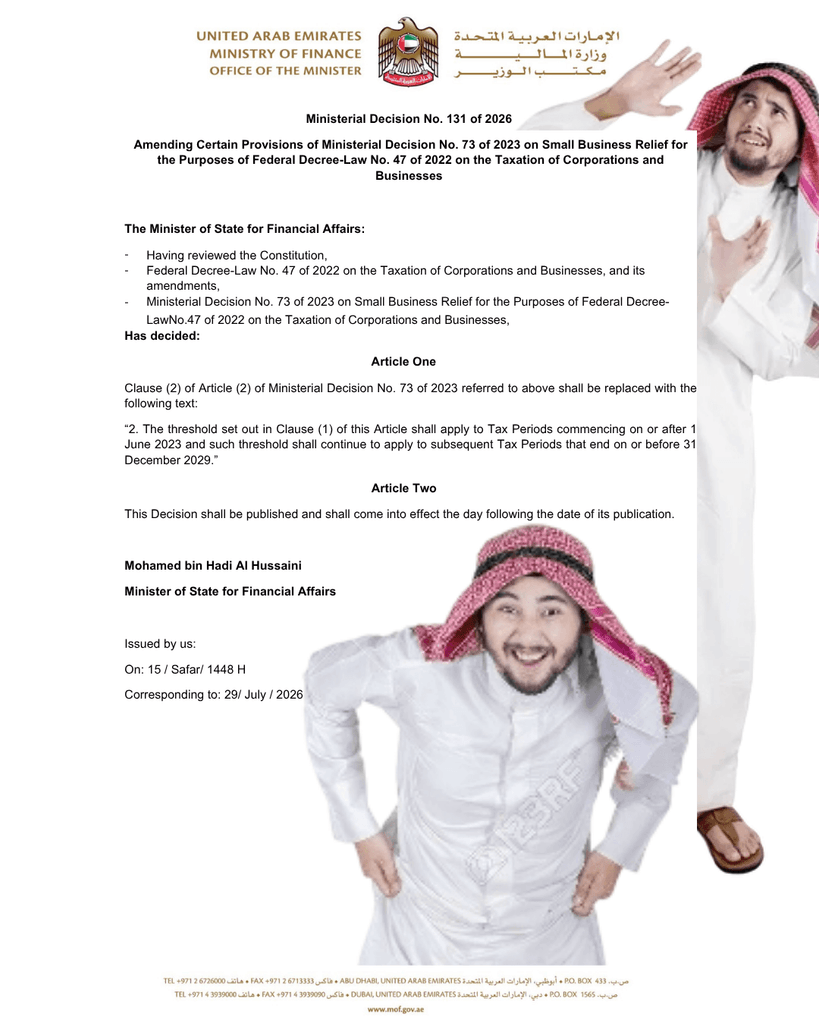
Ministerial Decision No. 131 of 2026 was issued on 29 July 2026 and announced on 7 August 2026. It amends the 2023 decision that created the relief. The main change is the end date. The previous cut-off was tax periods ending on or before 31 December 2026, and the new cut-off is 31 December 2029. The AED 3 million limit stays in place, and the decision takes effect the day after it is published. The new decision changes the end date and does not restate the eligibility conditions, which still come from the 2023 rules. The decision is written in Arabic, so the wording here is a translation. You can read the Ministry of Finance PDF of Decision 131 (Arabic) or visit the Ministry of Finance website.
Who qualifies, and where free zone companies fit
The relief applies to resident persons, and the rules come from federal law. Dubai and Sharjah companies therefore face the same test, and the differences come from where a company sits in the regime rather than which emirate it is in. A business qualifies only if its revenue does not exceed AED 3 million for the period it elects for and for every earlier tax period the test covers. Earlier periods count. A single earlier period above the limit can block an election for a later period.
Free zone companies are not excluded as a group. A Qualifying Free Zone Person (QFZP) cannot elect, whatever its revenue. The relief also excludes members of multinational groups that meet the group threshold of AED 3.15 billion in consolidated revenue. A free zone company that is a resident person and does not hold QFZP status for the period can in principle elect, provided it meets the revenue test. Because the exclusion turns on QFZP status rather than the free zone’s name, check that status for each period before relying on the relief. The UAE corporate tax guide for small businesses covers the wider regime, and the Dubai free zone vs mainland cost comparison helps you compare structures before you decide.
The election is not automatic: steps to elect
The relief does not apply on its own. The Federal Tax Authority (FTA) says eligible businesses must elect it through their Corporate Tax return, and each return covers one tax period. Work through these steps for each period you want to claim:
- Confirm the business is a resident person and, for that period, is neither a QFZP nor a member of an excluded multinational group.
- Add up revenue for the period and every earlier tax period the test covers, then compare the total against AED 3 million.
- Confirm the tax period ends on or before 31 December 2029.
- Make the election in the Corporate Tax return for that period. The FTA publishes return guidance on tax.gov.ae, and you should check the exact return section there before you file.
- File the return and pay any tax due within nine months after the period ends. For a year ending 31 December 2026, that deadline is 30 September 2027.
- Keep the records described below.
Electing businesses can file a simplified return, which asks for less information. The FTA’s headline says eligible businesses must submit simplified returns, while its text describes the simplified return as a benefit of electing. Confirm which applies to you before filing. Filing is still required even if you qualify, and the FTA warns that late submission can bring penalties. This guide does not list penalty amounts.
Electing also changes the tax result. The FTA says an eligible business is treated as having no taxable income for the period, which affects any losses it would otherwise carry forward. Get advice on that effect before you elect. The sources reviewed for this guide did not confirm whether a late election can be made, so treat the deadline as firm.
What Changed Under Ministerial Decision No. 131 of 2026?
The UAE Ministry of Finance published the extension announcement on 7 August 2026. The official decision, issued on 29 July 2026, replaces the previous end-date provision in Ministerial Decision No. 73 of 2023.
The revised provision states that the threshold applies to tax periods commencing on or after 1 June 2023 and continues to apply to subsequent tax periods ending on or before 31 December 2029.
Businesses should therefore distinguish between two dates:
- The start date: The relevant tax periods must fall within the scope of the rules.
- The end date: The tax period must end on or before 31 December 2029 to fall within the extended period.
The extension does not remove the other conditions in the Small Business Relief rules. Before making an election, a business should check the official decision and the Federal Tax Authority’s current guidance.
Official sources:
Who Can Qualify for the AED 3 Million Threshold?
The FTA’s published guidance identifies UAE resident natural persons and juridical persons as potential candidates for Small Business Relief, subject to the applicable conditions.
The main revenue test is whether revenue is AED 3 million or less in the relevant tax period and in all previous tax periods covered by the rules.
Do not check only the latest year’s revenue. A business that earned less than AED 3 million this year may still fail the test because its revenue exceeded the threshold in an earlier relevant tax period.
Before proceeding, check the following:
- Tax status: Confirm that the person or entity falls within the relevant category of resident taxable person.
- Current revenue: Establish the revenue for the tax period for which the election is being considered.
- Previous revenue: Review the revenue in all previous relevant tax periods.
- Exclusions: Confirm that the business is not disqualified because of its status or group membership.
- Election: Make the election through the relevant Corporate Tax Return if the business qualifies and wishes to use the relief.
Revenue is not the same as profit. A business can have low profit because its expenses are high while still exceeding the AED 3 million revenue threshold.
Use the accounting records and applicable accounting standards to establish the correct revenue figure rather than relying on the amount left in the business bank account.
Who Cannot Elect for Small Business Relief?
The FTA identifies two important exclusions.
Qualifying Free Zone Persons
A Qualifying Free Zone Person cannot elect for Small Business Relief.
This distinction is important for founders who operate through free-zone companies in Dubai or other UAE emirates. Having a free-zone licence does not, by itself, establish whether the entity is a Qualifying Free Zone Person.
The business should confirm its tax status before assuming that the relief is available. Where the classification is unclear, obtain advice based on the entity’s actual circumstances and the current rules.
Certain multinational groups
The FTA also excludes a member of a multinational enterprise group with consolidated group revenue exceeding AED 3.15 billion.
A small UAE subsidiary should not assume that it qualifies solely because its own revenue is below AED 3 million. Its group status may affect the outcome.
The business should check the applicable definition and conditions rather than relying on its standalone turnover alone.
How to Elect for Small Business Relief in Your Corporate Tax Return
The election must be made through the Corporate Tax Return. It is not a separate automatic benefit triggered by a low-revenue figure.
Step 1: Confirm Corporate Tax registration
Check whether the taxable person is registered for Corporate Tax and has the information needed to file its return through the FTA’s EmaraTax system.
Small Business Relief does not remove the registration requirement for a taxable person.
Step 2: Prepare the revenue calculation
Gather the accounting records for the current tax period and all previous relevant periods. Reconcile the revenue figures with the underlying transactions and financial records.
Do not use profit, cash remaining after expenses or the value of a single bank deposit as a substitute for the required revenue calculation.
Step 3: Review exclusions
Confirm whether the entity is a Qualifying Free Zone Person or a member of a multinational group that falls within the exclusion. Check any other applicable requirements before deciding to elect.
Step 4: Complete the Corporate Tax Return
When completing the return in EmaraTax, review the Small Business Relief election and the questions relevant to eligibility. Select the election only if the conditions are met and the business intends to use the relief.
Follow the current FTA return instructions. Do not rely solely on screenshots or old filing guides if the live return has changed.
Step 5: Submit the return and retain evidence
Submit the return within the applicable filing deadline. Keep the submitted return, confirmation and supporting records together.
The election must be considered for each tax period. Do not assume that making it for one year automatically applies it to later years.
The FTA’s official resources include its Corporate Tax topics and Corporate Tax Return taxpayer user manual.
Worked Example: A Dubai Service Business
The following figures are hypothetical and are provided only to explain the revenue test.
Suppose a Dubai-based resident service company has the following revenue:
| Tax period | Revenue |
|---|---|
| Year 1 | AED 1,800,000 |
| Year 2 | AED 2,400,000 |
| Year 3 | AED 2,700,000 |
Assume all three periods fall within the relevant rules, the company is not subject to an exclusion and all other conditions are met.
For Year 3, the company’s revenue is AED 2.7 million. Its revenue for each of the listed periods is also below AED 3 million. It may therefore be eligible to elect for Small Business Relief for Year 3.
Now consider a different history:
| Tax period | Revenue |
|---|---|
| Year 1 | AED 3,400,000 |
| Year 2 | AED 2,200,000 |
| Year 3 | AED 2,700,000 |
Although revenue in Year 3 is below AED 3 million, the business exceeded the threshold in Year 1. Under the published revenue test, it cannot assume that it qualifies for Year 3.
The lesson is simple: review the full relevant revenue history before making the election.
Which Records Should a Small Business Keep?
The FTA states that businesses must maintain records supporting the accuracy of their Corporate Tax Returns and eligibility for Small Business Relief. The documents required will depend on the nature of the business.
Prepare a record folder containing, as applicable:
- Sales invoices and other records of business transactions.
- Accounting ledgers and revenue reports for each relevant tax period.
- Financial statements and supporting accounting calculations.
- Bank statements and reconciliations that help substantiate recorded transactions.
- An asset register showing relevant asset purchases and disposals.
- Records of business liabilities.
- Records of shares or ownership interests held at the end of the tax period.
- Corporate Tax registration details and submitted returns.
- Evidence of the election and its submission.
- Documents needed to establish tax residence, entity classification or group status where relevant.
These records should agree with the figures reported in the return. If an amount has been adjusted, keep the calculation and supporting explanation.
Do not assume that filing a simplified return removes the need to retain evidence. The FTA may need to verify the business’s revenue and eligibility.
See the FTA’s guidance on Corporate Tax returns and supporting records.
Common Mistakes to Avoid
Assuming relief is automatic. Eligibility does not replace the requirement to make the election in the return.
Checking only the current year’s revenue. Previous relevant tax periods matter.
Confusing revenue with profit. Expenses can reduce profit without reducing revenue below the threshold.
Assuming every free-zone company qualifies. Qualifying Free Zone Persons are excluded.
Ignoring group membership. A business’s multinational group status can affect eligibility.
Stopping tax compliance after electing. Registration, return filing and record-keeping duties continue.
Failing to retain supporting documents. A revenue figure without supporting records can be difficult to substantiate.
A hypothetical worked example
Al Noor Trading LLC is a hypothetical mainland company, and every figure below is invented for illustration. It was set up on 1 January 2024 and has a calendar year-end. Its revenue was AED 1.6 million in 2024, AED 2.2 million in 2025, AED 2.5 million in 2026 and AED 2.4 million in 2027. It wants to elect for the year ended 31 December 2027.
Every period sits below AED 3 million, so the test passes whichever earlier periods are counted. The 2027 period ends before 31 December 2029, so it falls within the extension. Before filing, the company reconciles each year’s revenue to its sales ledger, so the figures it can show the FTA match the return. The company makes the election in its 2027 Corporate Tax return, which is due by 30 September 2028. Now change one figure. If 2025 revenue had reached AED 3.4 million, that earlier period would fail the test, and under the FTA’s wording the company could not elect for 2027 even though its 2027 revenue was lower.
Records to keep
The FTA says businesses should keep core records for each tax period, including transaction records, asset records, liability records, and records of shares or ownership interests held at the end of the period. The records a business needs depend on its activity. For this relief, the records that matter most are the ones that prove revenue for every period in the test. For Al Noor, that means sales invoices, sales ledgers, bank statements and annual financial statements for each year from 2024 onward. Be ready to show the FTA that revenue stayed within the threshold across all relevant periods. A simple habit helps here: store each period’s revenue summary and its supporting documents in one folder, so the revenue test can be checked quickly if the FTA asks. The FTA’s general Corporate Tax guidance says records should be kept for at least seven years after the end of the tax period, so plan storage with that in mind.
Common mistakes to avoid
Four mistakes come up often. The first is assuming the relief applies automatically because revenue looks small, when the election has to be made in the return. The second is checking only the current year’s revenue, when the test also looks at earlier periods. The third is overlooking group membership: a business that belongs to a large multinational group is excluded even if its own revenue is modest, so check the group position before electing. The fourth is treating 31 December 2029 as a loose target. The cut-off applies to tax periods that end on or before that date, so a period ending after it falls outside the extension.
Frequently asked questions
Is UAE small business relief automatic?
No. Eligible businesses must elect it through their Corporate Tax return for each tax period.
What is the revenue limit?
Revenue must not exceed AED 3 million for the period you elect for and for each earlier tax period the test covers. One earlier period above the limit can block the election.
Which tax periods does the 2029 extension cover?
Tax periods ending on or before 31 December 2029, under Ministerial Decision No. 131 of 2026.
Can a free zone company elect the relief?
Only if it is a resident person that is not a Qualifying Free Zone Person for the period and meets the other conditions. A QFZP cannot elect, whatever its revenue.
Do eligible businesses still file a Corporate Tax return?
Yes. The FTA says eligibility does not remove the duty to file a Corporate Tax return.
When is the return due?
Nine months after the end of the tax period. For a year ending 31 December 2026, the deadline is 30 September 2027.
Is the simplified return compulsory?
Sources differ. The FTA’s headline says eligible businesses must submit simplified returns, while its text describes the simplified return as a benefit of electing. Confirm the requirement with the FTA before you file.
Can I elect after the deadline?
The sources reviewed for this guide do not say. Treat the deadline as firm, and ask the FTA or a qualified adviser if you have missed it.
Which records should I keep?
Keep transaction, asset, liability and ownership records, plus revenue evidence for every period in the test, such as invoices, ledgers, bank statements and financial statements. Keep them for at least seven years after each period ends.
Next steps and important limits
This guide summarises public rules as of October 2026 and is not tax advice. The official Arabic text governs, several points remain unconfirmed, and your position depends on facts this guide does not have. Before you elect, confirm eligibility with the Federal Tax Authority or a qualified UAE tax adviser. For more on the wider regime, browse the corporate tax category on this site.