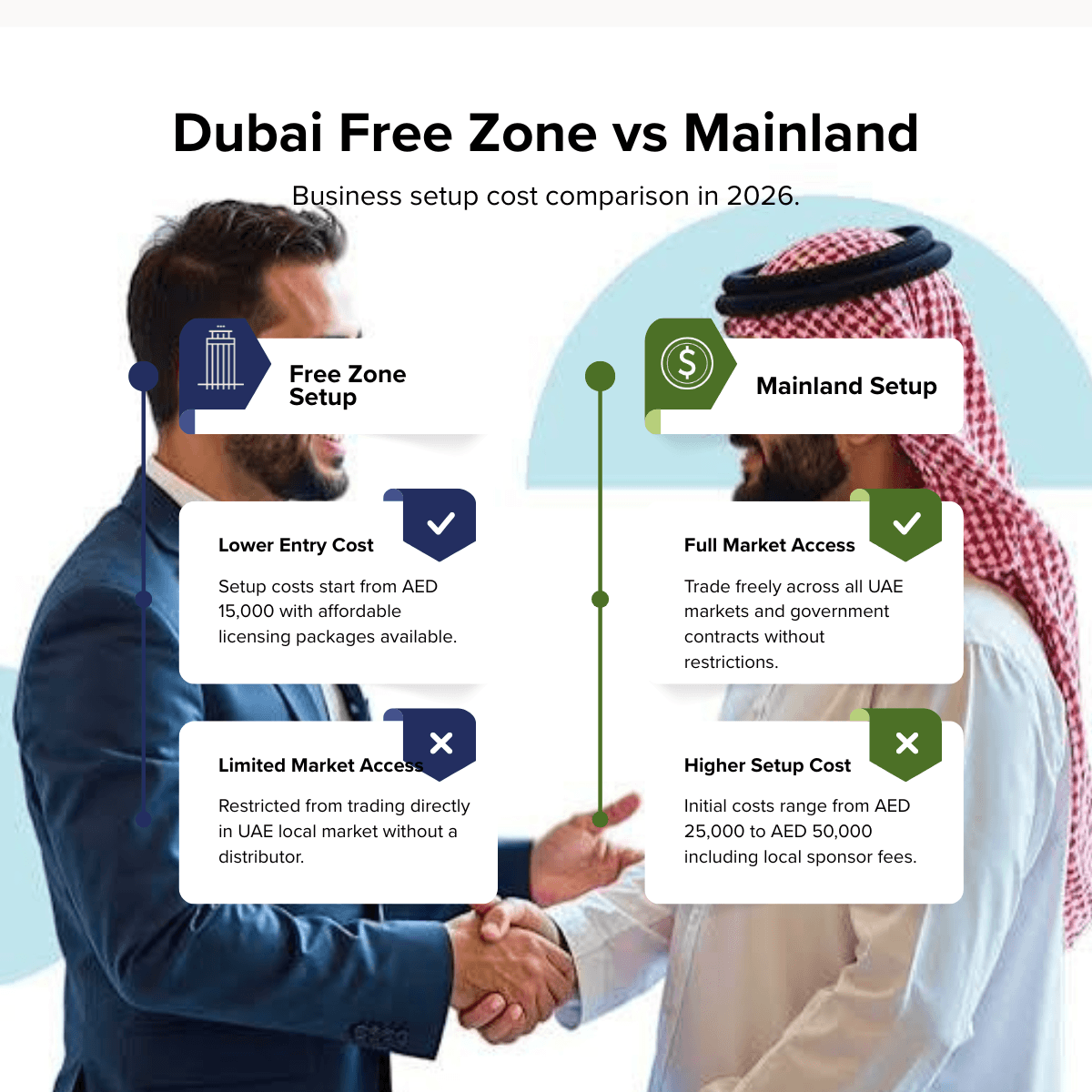
Starting a business in Dubai has become more accessible than ever, but many entrepreneurs still underestimate the actual cost. Promotional advertisements often highlight only the initial license fee while leaving out mandatory and optional expenses such as office space, immigration establishment cards, visa processing, medical examinations, Emirates ID issuance, corporate tax compliance, bookkeeping, annual renewals, and operational overhead.
For first-time founders, these hidden expenses can significantly increase the total investment required during the first year. A business that appears affordable based on its advertised setup package may ultimately cost considerably more once regulatory requirements and operating expenses are included.
One of the first decisions every investor must make is whether to establish a Mainland company or a Free Zone company. Both structures offer legitimate advantages, but they differ substantially in terms of market access, licensing requirements, office obligations, visa allocations, regulatory compliance, and long-term scalability.
Rather than focusing solely on the advertised registration fee, a more effective approach is to calculate the Total Cost of Ownership (TCO) over the first three years. This includes setup expenses, recurring government fees, operational costs, tax obligations, and future expansion requirements.
This guide provides a practical, line-by-line comparison of the costs associated with both business structures. It also explains which expenses are mandatory, which are optional, and which are frequently overlooked during the planning stage.
For many freelancers, consultants, digital businesses, and international entrepreneurs, a Free Zone company generally offers a lower initial investment and a faster registration process. Many Free Zones provide flexible office solutions, streamlined incorporation procedures, and simplified administrative requirements.
Mainland companies generally involve higher startup costs because physical office requirements and additional regulatory obligations often apply. However, they provide greater flexibility for businesses intending to operate directly within the UAE market, participate in government tenders (where eligible), or establish a broader local commercial presence.
The most affordable option is not necessarily the least expensive package advertised online. The better choice depends on factors such as:
- Business activity
- Number of shareholder visas required
- Office requirements
- Target customers
- Expected annual revenue
- Expansion plans
- Corporate tax obligations
- Future hiring plans
Businesses focused primarily on international trade or remote services may find a Free Zone structure more cost-effective. Businesses planning significant operations within the UAE domestic market may benefit from a Mainland structure despite the higher initial investment.
- Consulting
- Trading
- Logistics
- Manufacturing
- Education
- Healthcare
Free Zones usually simplify the incorporation process by offering bundled packages that may include licensing, flexi-desk facilities, and visa eligibility.
The exact benefits, permitted activities, office options, and visa allocations vary by Free Zone. They should always be confirmed with the relevant Free Zone authority before making a decision.
Key Differences
| Comparison Area | Mainland | Free Zone |
|---|---|---|
| Business Registration | Government licensing authority | Individual Free Zone authority |
| Office Requirement | Commercial office commonly required | Flexi-desk or office options available in many Free Zones |
| UAE Market Operations | Broad access subject to licensing rules | Depends on activity and applicable regulations |
| Business Expansion | Flexible for UAE-wide operations | Expansion may require additional approvals depending on business model |
| Setup Process | Can involve more documentation | Often streamlined |
| Annual Operating Costs | Usually higher due to office expenses | Often lower for smaller businesses |
| Ideal For | Local service providers, retail, construction, restaurants | Consultants, freelancers, digital businesses, international trading |
Cost Impact Comparison
| Expense Category | Mainland | Free Zone |
|---|---|---|
| Business License | Medium–High | Low–Medium |
| Office Rental | High | Low–Medium |
| Visa Processing | Similar government-related costs | Similar government-related costs |
| Annual Renewal | Higher where office costs are significant | Often lower for smaller packages |
| Accounting & Compliance | Similar legal obligations where applicable | Similar legal obligations where applicable |
| Expansion Costs | Lower once local infrastructure exists | May increase if upgrading facilities or moving jurisdictions |
Advantages and Limitations
| Mainland Advantages | Potential Challenges |
|---|---|
| Broad operational presence within the UAE | Higher startup costs |
| Greater flexibility for physical business operations | Office rental increases annual expenses |
| Easier long-term scaling for many local businesses | More administrative requirements |
| Suitable for larger workforces | Higher operating overhead |
| Free Zone Advantages | Potential Challenges |
|---|---|
| Lower entry cost for many startups | Business activity options vary by Free Zone |
| Faster company formation | Expansion requirements differ between authorities |
| Flexible office packages | Office upgrades may be needed as the business grows |
| Suitable for international service businesses | Selecting the wrong Free Zone can increase future costs |
Common Problems and Practical Solutions
| Common Problem | Why It Happens | Practical Solution |
|---|---|---|
| Choosing the cheapest package | Hidden fees are not included | Compare total first-year costs rather than license fees alone. |
| Buying more visas than needed | Poor planning | Estimate staffing requirements for the first 24 months before selecting a package. |
| Paying for unnecessary office space | Growth assumptions are unrealistic | Start with an appropriate office solution and upgrade only when operationally necessary. |
| Selecting the wrong business activity | Activity requirements differ | Verify that the planned activities are covered before incorporation. |
| Ignoring annual renewal costs | Focus remains on setup fees | Prepare a three-year operating budget including renewals and compliance costs. |
| Delayed tax registration | Compliance obligations are overlooked | Review corporate tax and VAT obligations immediately after incorporation, where applicable. |
Expert Planning Tips
- Compare the total first-year investment, not just the advertised setup fee.
- Budget separately for government fees, office costs, visas, insurance, accounting, and renewals.
- Choose a business activity that supports planned expansion over the next three to five years.
- Avoid selecting a jurisdiction solely because it offers the lowest advertised package.
- Review visa requirements before registration to reduce future amendment costs.
- Maintain a contingency reserve for regulatory changes and unexpected operating expenses.
Complete Startup Cost Breakdown (2026)
Complete Startup Cost Breakdown: Free Zone vs Mainland
The advertised company formation fee is only one component of the total investment required to establish a business in Dubai. Every business should prepare a detailed budget that separates one-time setup costs from recurring annual expenses.
The exact amount varies depending on the business activity, licensing authority, office requirements, visa allocation, and regulatory obligations. The categories below represent the principal cost components that entrepreneurs should evaluate before committing to a setup package.
One-Time Startup Expenses
1. Trade License
The trade license is the legal authorization that allows the company to conduct approved business activities.
The licensing cost depends on factors such as:
- Business activity
- Legal structure
- Number of shareholders
- Jurisdiction
- Package inclusions
- Regulatory approvals (where required)
Some promotional packages include only the license issuance fee and exclude other mandatory government charges.
Planning Tip
Always request an itemized quotation showing each government fee separately rather than accepting a single bundled price.
2. Company Registration Fees
Most jurisdictions charge registration or incorporation fees in addition to the business license.
These may include:
- Company registration
- Name reservation
- Initial approval
- Incorporation documentation
- Digital registration services
- Administrative processing
Some setup providers include these costs in their packages, while others list them separately.
3. Office Costs
Office expenses often become one of the largest recurring business costs.
Possible options include:
| Office Type | Typical Business Use |
|---|---|
| Flexi Desk | Freelancers and small consulting businesses |
| Shared Workspace | Startups with limited staff |
| Serviced Office | Growing SMEs |
| Private Commercial Office | Medium and large businesses |
| Warehouse | Trading and logistics companies |
| Retail Premises | Shops, restaurants, customer-facing businesses |
Office size can directly influence visa eligibility in many jurisdictions.
4. Immigration Establishment Card
Businesses planning to sponsor employees or investors typically require an immigration establishment file before processing residence visas.
This is a government requirement and should be included in the initial setup budget.
5. Investor and Employee Visa Costs
Visa-related expenses commonly include:
- Entry permit (where applicable)
- Status adjustment
- Medical fitness examination
- Emirates ID
- Residence visa issuance
- Visa stamping or digital processing
- Administrative service charges
Businesses planning to hire multiple employees should estimate visa costs over the first two years rather than budgeting only for the initial owner visa.
6. Medical Examination
Residence visa applicants generally complete a government-approved medical fitness examination.
The applicable process and fees depend on the selected service level and current government requirements.
7. Emirates ID
Every eligible UAE resident receives an Emirates ID following completion of the residence process.
The validity period depends on the approved visa duration.
Businesses should include Emirates ID renewal costs in long-term operating budgets.
8. Corporate Bank Account Setup
Opening a corporate bank account does not usually involve a government licensing fee, but businesses should prepare for:
- Minimum balance requirements (where applicable)
- Compliance documentation
- Know Your Customer (KYC) reviews
- Proof of business activities
- Source-of-funds verification
Approval timelines vary between financial institutions.
9. Accounting and Bookkeeping
Many new businesses underestimate accounting costs.
Typical services include:
- Monthly bookkeeping
- Financial statements
- VAT record maintenance (where applicable)
- Corporate tax documentation
- Payroll records
- Annual reporting support
Maintaining accurate financial records from the beginning reduces future compliance risks.
10. Corporate Tax Compliance
Businesses should determine whether they are required to register for UAE Corporate Tax and maintain the necessary accounting records.
Potential compliance costs include:
- Registration assistance
- Accounting software
- Tax advisory services
- Annual tax return preparation
- Record retention
Compliance obligations should be reviewed with qualified advisers based on the company’s circumstances.
Hidden Costs Often Missed
Many entrepreneurs focus on the advertised package price and overlook additional operational expenses.
Common examples include:
- Document translation
- Attestation services
- Courier charges
- Bank compliance updates
- Insurance premiums
- Office upgrades
- Business activity amendments
- License modifications
- Additional shareholder documentation
- Visa amendments
- Renewal processing fees
Individually these expenses may appear modest, but collectively they can have a noticeable impact on the first-year budget.
First-Year Cost Planning Checklist
| Expense Category | One-Time | Annual |
|---|---|---|
| Trade License | ✓ | Renewal |
| Company Registration | ✓ | — |
| Office Rental | ✓ | ✓ |
| Immigration Establishment Card | ✓ | Renewal where applicable |
| Investor Visa | ✓ | Renewal |
| Employee Visas | ✓ | Renewal |
| Medical Examination | ✓ | Renewal with visa cycle |
| Emirates ID | ✓ | Renewal |
| Accounting | — | ✓ |
| Corporate Tax Compliance | — | ✓ |
| Insurance | — | ✓ |
| Bank Compliance | — | ✓ |
Common Budgeting Mistakes
| Mistake | Financial Impact | Recommended Approach |
|---|---|---|
| Comparing only license prices | Underestimates total investment | Compare complete first-year costs. |
| Ignoring office upgrades | Unexpected annual expenses | Select office space based on realistic growth. |
| Excluding visa renewals | Cash flow pressure | Build renewal costs into yearly budgets. |
| No contingency reserve | Difficulty covering unforeseen expenses | Allocate a contingency fund for regulatory and operational changes. |
| Delaying bookkeeping | Compliance risks | Establish accounting processes from day one. |
Expert Planning Tips
- Prepare separate budgets for setup costs and annual operating costs.
- Request written quotations with every fee itemized.
- Review package inclusions carefully to identify excluded government charges.
- Estimate staffing needs before selecting visa allocations.
- Include renewal costs when comparing business structures.
- Maintain a contingency reserve to absorb unexpected regulatory or operational expenses.

Government Fees and Regulatory Charges (2026)
Government fees are a significant component of the total cost of starting and operating a business in Dubai. These charges extend beyond the initial trade license and can include approvals, registrations, renewals, immigration-related services, and ongoing compliance obligations.
Understanding which fees are mandatory, which are activity-dependent, and which are optional helps businesses prepare a more accurate budget and avoid unexpected costs during incorporation.
Important: Government fee structures and administrative procedures may change. Businesses should always confirm current charges and requirements with the relevant licensing authority before submitting an application.
How Government Fees Are Structured
Government-related charges generally fall into four categories:
| Category | Purpose | Typical Timing |
|---|---|---|
| Incorporation Fees | Company formation and registration | One-time |
| Licensing Fees | Permission to conduct approved activities | Initial issue and annual renewal |
| Immigration Services | Residence visa and establishment file processing | As required |
| Regulatory Compliance | Ongoing statutory obligations | Annual or event-based |
Understanding this structure helps distinguish between the initial setup cost and the long-term cost of maintaining the business.
Common Government Fee Categories
Although the exact combination varies by jurisdiction and business activity, entrepreneurs commonly encounter the following categories during company formation:
| Government Requirement | Why It Is Required |
|---|---|
| Trade Name Reservation | Reserves the company name during incorporation |
| Initial Approval | Confirms eligibility to proceed with registration |
| Company Registration | Establishes the legal entity |
| Trade License Issuance | Authorizes approved business activities |
| Establishment File | Enables immigration-related services where applicable |
| Residence Visa Processing | Supports investor and employee residency applications |
| Emirates ID Services | Identity registration for eligible residents |
| Business Amendments | Updates to ownership, activities, or company details |
| Annual License Renewal | Keeps the business legally active |
Not every business will require every service, but understanding these categories helps identify which costs may apply.
Mainland and Free Zone Regulatory Differences
The regulatory framework differs between Mainland companies and Free Zone companies.
| Regulatory Area | Mainland | Free Zone |
|---|---|---|
| Licensing Authority | Relevant Dubai licensing authority | Individual Free Zone authority |
| Company Administration | Governed by applicable mainland regulations | Managed by the Free Zone authority |
| Office Requirements | Commercial office commonly required | Flexi-desk, shared, or private office depending on package |
| Immigration Services | Processed through applicable authorities | Coordinated through the Free Zone where applicable |
| Company Amendments | Subject to relevant approval procedures | Subject to Free Zone rules and procedures |
The practical effect is that the application process, documentation requirements, and administrative timelines can differ depending on the chosen jurisdiction.
Annual Renewal Obligations
Company formation is not a one-time administrative process. Businesses should plan for recurring obligations that may include:
- Trade license renewal
- Office lease renewal (where applicable)
- Establishment file renewal (if required)
- Residence visa renewals
- Emirates ID renewals
- Insurance renewals
- Accounting and financial record maintenance
- Corporate tax and VAT compliance (where applicable)
Preparing for these recurring requirements reduces the likelihood of operational disruptions.
Hidden Government-Related Costs
Some expenses arise only after the company has been established.
Examples include:
| Hidden Cost | Why It Occurs | Planning Strategy |
|---|---|---|
| Company activity amendments | Business model changes | Select appropriate activities during incorporation |
| Additional shareholder documentation | Ownership changes | Plan ownership structure before registration |
| License reissuance | Administrative updates | Minimize avoidable amendments |
| Office upgrades | Business expansion | Choose office space with realistic growth expectations |
| Visa quota increases | Workforce growth | Estimate hiring needs in advance |
| Document attestation | Cross-border or regulated transactions | Confirm documentation requirements early |
These costs are not universal but should be considered when preparing a contingency budget.
Regulatory Compliance Timeline
The following timeline provides a high-level overview of common compliance milestones during the first year of operation.
| Stage | Typical Activity |
|---|---|
| Before Incorporation | Select business activity, legal structure, and jurisdiction |
| Company Formation | Obtain approvals and complete registration |
| After Incorporation | Apply for immigration services (if required) and establish operational systems |
| First Months | Open corporate bank account, implement bookkeeping, assess tax obligations |
| Throughout the Year | Maintain records, monitor compliance deadlines, renew services as required |
| Annual Review | Renew licenses and review business structure for future growth |
Using a compliance calendar helps reduce the risk of missed deadlines.
Common Compliance Mistakes
| Mistake | Potential Consequence | Recommended Solution |
|---|---|---|
| Focusing only on setup fees | Underestimated operating costs | Prepare a multi-year budget |
| Missing renewal deadlines | Administrative delays or penalties | Track all renewal dates in advance |
| Delaying bookkeeping | Increased compliance workload | Maintain records from the start |
| Selecting incorrect business activities | Future amendments may be required | Confirm activity selection before registration |
| Ignoring future staffing needs | Additional administrative changes | Align visa planning with hiring forecasts |
Best Practices for Managing Government Costs
- Request an itemized quotation showing every government fee.
- Distinguish mandatory charges from optional services.
- Budget separately for setup and annual renewals.
- Maintain a compliance calendar for licenses, visas, and tax obligations.
- Review your business structure annually to ensure it continues to meet operational needs.
- Keep digital copies of approvals, licenses, and compliance records in a secure document management system.
Government Fee Planning Checklist
| Checklist Item | Status |
|---|---|
| Business activity confirmed | ☐ |
| Jurisdiction selected | ☐ |
| Trade name approved | ☐ |
| Incorporation documents prepared | ☐ |
| Office requirements reviewed | ☐ |
| Visa requirements estimated | ☐ |
| Compliance calendar created | ☐ |
| Renewal budget prepared | ☐ |
| Accounting process established | ☐ |
| Tax obligations assessed | ☐ |
Office Requirements and Visa Quotas (2026)
Office Requirements and Visa Quotas: Planning Beyond the First Year
Office selection is one of the most important cost drivers when establishing a business in Dubai. While many entrepreneurs focus on obtaining the lowest-cost company formation package, the office chosen during incorporation can influence future operating costs, staffing capacity, business flexibility, and expansion planning.
Likewise, visa allocation should not be viewed simply as the number of visas included in a setup package. Businesses should estimate their workforce requirements over the next two to three years and choose a solution that supports planned growth rather than immediate needs alone.
The exact office and visa rules vary between jurisdictions and may change over time. Requirements should always be confirmed with the relevant licensing authority before making a final decision.
Understanding Office Options
Different office solutions are designed for different stages of business growth.
| Office Type | Suitable For | Key Characteristics |
|---|---|---|
| Flexi Desk | Freelancers, solo consultants, early-stage startups | Shared workspace with limited physical office access in many Free Zones |
| Shared Office | Small businesses | Dedicated workspace shared with other companies |
| Serviced Office | Growing SMEs | Private office with reception and support services |
| Private Commercial Office | Established companies | Exclusive office space suitable for larger teams |
| Warehouse | Trading, logistics, manufacturing | Storage and operational facilities |
| Retail Unit | Customer-facing businesses | Commercial premises for direct public interaction |
The appropriate office depends on business activity, expected staffing, operational requirements, and long-term growth plans.
How Office Choice Affects Business Costs
Office expenses extend beyond the initial lease.
Businesses should also consider:
- Utility charges
- Internet and telecommunications
- Office furniture and equipment
- Maintenance fees
- Parking (where applicable)
- Security deposits
- Office fit-out costs
- Cleaning and facility management
- Future office upgrades
For many businesses, office-related expenses become one of the largest recurring operational costs after salaries.
Visa Quotas Explained
A visa quota represents the number of residence visas a business may be eligible to sponsor, subject to the applicable rules of the licensing authority and immigration regulations.
The available quota is influenced by factors such as:
- Office type
- Office size
- Jurisdiction
- Business activity
- Regulatory requirements
Businesses planning to recruit employees should evaluate visa capacity during the incorporation stage rather than after hiring begins.
Planning Visa Requirements
Instead of selecting a package based solely on the number of visas initially included, estimate staffing needs over the first three years.
Example Workforce Planning
| Business Stage | Expected Team Size | Planning Consideration |
|---|---|---|
| Startup | Founder only | Basic office solution may be sufficient |
| Growth Phase | 2–5 employees | Review office and visa capacity |
| Expansion | 6–15 employees | Larger office and additional operational planning may be required |
| Established Business | 15+ employees | Long-term office strategy becomes increasingly important |
A realistic hiring forecast helps reduce the need for frequent amendments and office upgrades.
Office Comparison
| Feature | Flexi Desk | Shared Office | Private Office |
|---|---|---|---|
| Initial Cost | Lowest | Moderate | Highest |
| Privacy | Low | Medium | High |
| Expansion Flexibility | Limited | Moderate | High |
| Team Collaboration | Limited | Good | Excellent |
| Client Meetings | Limited | Available in many facilities | Fully suitable |
| Long-Term Scalability | Limited | Moderate | High |
The most economical option at incorporation may not remain the most cost-effective as the business grows.
Advantages and Limitations
| Office Solution | Advantages | Limitations |
|---|---|---|
| Flexi Desk | Lower startup investment, simple administration | Limited workspace and expansion capacity |
| Shared Office | Cost-effective balance between flexibility and functionality | Less privacy than dedicated premises |
| Private Office | Greater operational control, stronger business presence | Higher recurring costs |
Common Problems and Practical Solutions
| Common Problem | Why It Happens | Practical Solution |
|---|---|---|
| Choosing the smallest office solely to reduce setup costs | Focus on short-term savings | Select office space that aligns with projected staffing for the next 24–36 months. |
| Underestimating visa needs | Hiring plans are not prepared before incorporation | Develop a workforce forecast before selecting a business package. |
| Frequent office upgrades | Rapid business growth without capacity planning | Review office requirements annually and upgrade only when operationally justified. |
| Paying for unused office space | Overestimating growth | Match office size to realistic business projections and reassess periodically. |
| Ignoring operating expenses | Budget focuses only on rent | Include utilities, maintenance, connectivity, and facility costs in annual financial planning. |
Office Selection Framework
Before committing to an office solution, evaluate the following questions:
| Planning Question | Why It Matters |
|---|---|
| How many employees are expected within three years? | Influences office capacity and workforce planning |
| Will clients regularly visit the office? | Determines the need for meeting rooms and reception facilities |
| Is physical inventory stored on-site? | May require warehouse or commercial premises |
| Will expansion into additional Emirates be considered? | Affects long-term location strategy |
| Is remote or hybrid work part of the business model? | May reduce the need for larger office space |
Best Practices
- Base office selection on operational needs rather than promotional offers.
- Prepare a three-year staffing forecast before deciding on visa capacity.
- Compare the total annual occupancy cost rather than rental price alone.
- Review lease terms for flexibility and future expansion.
- Reassess office requirements annually as the business evolves.
- Maintain a contingency budget for relocation or expansion if growth exceeds initial projections.
Office and Visa Planning Checklist
| Checklist Item | Status |
|---|---|
| Business activity confirmed | ☐ |
| Workforce forecast prepared | ☐ |
| Office type selected | ☐ |
| Operating costs estimated | ☐ |
| Visa requirements reviewed | ☐ |
| Expansion plan documented | ☐ |
| Lease obligations understood | ☐ |
| Annual occupancy budget prepared | ☐ |
Corporate Tax Registration and VAT Compliance (2026)
Corporate Tax Registration and VAT Compliance
Registering a company is only the first step in establishing a compliant business in Dubai. Once operations begin, businesses must understand their ongoing tax and accounting obligations. These responsibilities vary depending on the company’s legal structure, business activity, taxable income, and turnover.
A common misconception is that Free Zone companies have no tax responsibilities or that VAT applies automatically to every business. In reality, the applicable rules depend on the company’s circumstances and the prevailing legislation.
Important: Tax obligations should always be assessed using the latest guidance issued by the relevant UAE authorities and, where appropriate, with advice from a qualified tax professional.
Understanding UAE Corporate Tax
The UAE Corporate Tax framework applies to many businesses operating in the country, although the exact treatment depends on factors such as:
- Business structure
- Nature of business activities
- Taxable income
- Applicable exemptions or reliefs
- Relevant regulatory requirements
Corporate Tax compliance generally involves:
- Registration where required
- Maintaining accounting records
- Preparing financial statements
- Calculating taxable income
- Filing tax returns within prescribed deadlines
- Retaining supporting documentation
Tax registration should not be delayed simply because a business is newly established.
VAT Registration
Value Added Tax (VAT) is separate from Corporate Tax.
Whether a business must register for VAT depends on the applicable registration thresholds and its taxable activities.
Businesses should monitor:
- Annual taxable turnover
- Expected future turnover
- Taxable supplies
- Import and export activities
- Record-keeping requirements
Even businesses that are not currently required to register should regularly review their turnover to determine whether registration becomes necessary.
Corporate Tax vs VAT
| Comparison | Corporate Tax | VAT |
|---|---|---|
| Purpose | Tax on taxable business profits | Tax on eligible taxable supplies and services |
| Registration | Required where applicable | Depends on statutory thresholds and business activities |
| Filing | Periodic tax return | Periodic VAT return |
| Record Keeping | Required | Required |
| Financial Reporting | Supports tax compliance | Supports VAT compliance |
Although both require accurate accounting records, they serve different purposes within the UAE tax system.
Why Bookkeeping Matters
Accurate bookkeeping is the foundation of tax compliance.
Proper accounting records help businesses:
- Prepare financial statements
- Calculate tax liabilities
- Monitor cash flow
- Track business expenses
- Support audits and reviews
- Demonstrate regulatory compliance
Poor financial records often result in higher advisory costs and additional administrative work later.
Essential Financial Records
Businesses should maintain organized records such as:
| Record Type | Purpose |
|---|---|
| Sales Invoices | Revenue documentation |
| Purchase Invoices | Expense verification |
| Bank Statements | Financial reconciliation |
| Payroll Records | Employee payments |
| Supplier Contracts | Commercial evidence |
| Customer Agreements | Revenue support |
| Tax Returns | Compliance documentation |
| Accounting Ledgers | Financial reporting |
| Import and Export Documents | Customs and tax support where applicable |
Digital record management can improve accuracy and simplify future reporting.
Compliance Calendar
The exact reporting schedule depends on the company’s obligations, but businesses should maintain a compliance calendar covering:
| Compliance Activity | Frequency |
|---|---|
| Bookkeeping | Ongoing |
| Bank Reconciliation | Monthly |
| Financial Review | Monthly or Quarterly |
| VAT Review (where applicable) | As required |
| Corporate Tax Review | Annual or as required |
| Trade License Renewal | Annual |
| Visa Renewals | According to visa validity |
| Accounting Record Review | Annual |
Maintaining a structured calendar reduces the likelihood of missed deadlines.
Common Tax and Compliance Mistakes
| Mistake | Potential Impact | Recommended Solution |
|---|---|---|
| Delaying bookkeeping | Incomplete financial records | Record transactions consistently from the start. |
| Mixing personal and business finances | Difficult financial reporting | Maintain separate business banking and accounting records. |
| Ignoring VAT turnover | Late registration risk | Monitor taxable turnover throughout the year. |
| Assuming no Corporate Tax obligations | Compliance issues | Review tax status regularly based on current regulations. |
| Poor document retention | Difficulty supporting filings | Store financial records securely and systematically. |
Practical Tax Planning Tips
- Implement accounting software early in the business lifecycle.
- Reconcile bank accounts regularly.
- Maintain supporting documentation for all business transactions.
- Schedule periodic financial reviews rather than waiting until year-end.
- Monitor turnover to identify VAT registration obligations promptly.
- Keep tax compliance responsibilities separate from operational budgeting to improve financial planning.
Compliance Checklist
| Checklist Item | Status |
|---|---|
| Accounting system implemented | ☐ |
| Business bank account operational | ☐ |
| Financial records organized | ☐ |
| Tax obligations assessed | ☐ |
| VAT registration reviewed | ☐ |
| Corporate Tax registration reviewed | ☐ |
| Compliance calendar created | ☐ |
| Supporting documents archived | ☐ |
| Annual reporting process planned | ☐ |
Advantages of Early Compliance
| Benefit | Long-Term Value |
|---|---|
| Accurate bookkeeping | Better financial visibility |
| Timely registrations | Reduced compliance risk |
| Organized records | Faster audits and reporting |
| Regular financial reviews | Improved cash flow management |
| Structured compliance calendar | Fewer missed deadlines |
Potential Challenges and Solutions
| Challenge | Likely Cause | Practical Solution |
|---|---|---|
| Cash flow pressure during tax periods | No advance budgeting | Allocate funds for future tax obligations throughout the year. |
| Missing filing deadlines | No compliance tracking | Use a centralized compliance calendar with reminders. |
| Incomplete documentation | Manual record management | Adopt digital document storage with standardized filing practices. |
| Unclear tax responsibilities | Business growth changes obligations | Conduct periodic compliance reviews as the business expands. |
Hidden Costs Most Agencies Don’t Tell You (2026)
Hidden Costs That Can Significantly Increase Your First-Year Budget
Many business setup advertisements focus on the lowest possible entry price. While these offers can be legitimate, they often emphasize the initial license fee rather than the total cost of establishing and operating a company during its first year.
For entrepreneurs comparing multiple proposals, the difference between two quotations is often not the license itself but the number of services and government requirements included.
The most reliable way to evaluate a proposal is to request a complete, itemized quotation that separates government fees, professional service charges, optional services, and recurring annual costs.
Where Hidden Costs Usually Appear
The following categories are commonly overlooked during the planning stage.
| Cost Category | Why It Is Often Missed | Budget Planning Tip |
|---|---|---|
| Office upgrades | Initial package includes only a basic workspace | Estimate future office needs over the next 24–36 months. |
| Visa processing services | Promotional pricing may assume a license without visas | Budget separately for each planned residence visa. |
| Medical examinations | Often viewed as part of the visa process rather than a separate cost | Include all immigration-related expenses in the setup budget. |
| Emirates ID renewals | Considered only after visa approval | Track renewal cycles in the compliance calendar. |
| Accounting services | Frequently postponed during startup | Implement bookkeeping from the first month of operation. |
| Insurance | Not always highlighted in setup quotations | Review insurance requirements before operations begin. |
| Banking compliance | Additional documentation may be requested | Prepare complete business records before account application. |
| Company amendments | Business activities or ownership may change | Select the appropriate structure and activities at incorporation. |
Hidden Operational Costs
After incorporation, businesses begin incurring operational expenses that may not have been part of the original setup estimate.
Examples include:
- Internet and telecommunications
- Office utilities
- Software subscriptions
- Cloud storage
- Accounting software
- Payroll administration
- Professional memberships
- Marketing and advertising
- Website maintenance
- Cybersecurity services
- Business insurance
- Staff training
These recurring costs often exceed the one-time incorporation expenses over the life of the business.
Three-Year Cost Planning
Instead of preparing only for the first month, businesses should estimate their financial requirements over the first three years.
| Business Stage | Primary Cost Focus |
|---|---|
| Year 1 | Company formation, licensing, office setup, visas |
| Year 2 | Renewals, staffing, marketing, compliance |
| Year 3 | Expansion, larger office, additional employees, operational scaling |
A multi-year budget provides a more realistic picture of the company’s financial needs.
One-Time vs Recurring Costs
| Expense | One-Time | Recurring |
|---|---|---|
| Company registration | ✓ | — |
| Trade license issuance | ✓ | Renewal |
| Office fit-out | ✓ | — |
| Office rent | — | ✓ |
| Utilities | — | ✓ |
| Internet services | — | ✓ |
| Insurance | — | ✓ |
| Accounting | — | ✓ |
| Payroll administration | — | ✓ |
| License renewal | — | ✓ |
| Visa renewal | — | ✓ |
| Corporate Tax compliance | — | ✓ |
| VAT compliance (where applicable) | — | ✓ |
Understanding this distinction helps businesses forecast future cash flow more accurately.
Risk Assessment Matrix
| Risk | Likelihood | Business Impact | Mitigation Strategy |
|---|---|---|---|
| Underestimating startup costs | High | High | Prepare a detailed first-year budget with contingency. |
| Office expansion earlier than expected | Medium | Medium | Select an office solution that allows gradual scaling. |
| Hiring beyond visa capacity | Medium | High | Review workforce forecasts before incorporation. |
| Compliance deadlines missed | Medium | High | Maintain a centralized compliance calendar. |
| Cash flow constraints | Medium | High | Build an operating reserve covering several months of fixed expenses. |
Advantages of Comprehensive Budgeting
| Advantage | Business Benefit |
|---|---|
| Better financial forecasting | Improved investment planning |
| Reduced unexpected expenses | Greater cash flow stability |
| Easier lender and investor discussions | More credible financial projections |
| Improved compliance planning | Lower administrative risk |
| Better expansion decisions | Sustainable long-term growth |
Common Planning Mistakes and Solutions
| Mistake | Result | Practical Solution |
|---|---|---|
| Comparing only advertised setup prices | Total investment underestimated | Compare complete first-year and renewal costs. |
| No contingency budget | Unexpected expenses affect operations | Maintain a dedicated contingency reserve. |
| Delaying accounting | Financial records become difficult to reconstruct | Start bookkeeping immediately after incorporation. |
| Ignoring technology costs | Operating budget becomes unrealistic | Include software and digital services in annual planning. |
| Underestimating marketing expenses | Slower customer acquisition | Allocate a realistic marketing budget from the outset. |
Cost-Control Strategies
Businesses can improve financial efficiency without compromising compliance by following a structured approach.
Before Incorporation
- Define business activities carefully.
- Estimate staffing requirements.
- Compare multiple jurisdictions.
- Request fully itemized quotations.
- Prepare a first-year operating budget.
During Incorporation
- Maintain organized documentation.
- Track all government approvals.
- Establish accounting systems.
- Open business banking promptly.
- Create a compliance calendar.
After Incorporation
- Monitor monthly operating expenses.
- Review budgets quarterly.
- Plan renewal costs well in advance.
- Evaluate office requirements annually.
- Update financial forecasts as the business grows.
Financial Planning Checklist
| Planning Item | Status |
|---|---|
| Setup budget prepared | ☐ |
| Annual operating budget created | ☐ |
| Renewal costs estimated | ☐ |
| Contingency reserve allocated | ☐ |
| Office expenses reviewed | ☐ |
| Technology costs included | ☐ |
| Insurance requirements assessed | ☐ |
| Marketing budget planned | ☐ |
| Compliance calendar maintained | ☐ |
Expert Insight
Businesses that evaluate lifetime operating costs rather than promotional setup prices are generally better positioned to make informed decisions. A structured budget that includes renewals, staffing, technology, compliance, and expansion costs provides a more reliable foundation for sustainable growth than focusing solely on incorporation expenses.
Three-Year Cost Comparison and Decision Framework (2026)
Looking Beyond the Setup Fee: The Three-Year Cost of Ownership
Most entrepreneurs compare company formation options using the advertised setup package. While this approach may identify the lowest initial investment, it does not reflect the actual financial commitment required to operate a business over time.
A more reliable method is to evaluate the Total Cost of Ownership (TCO) over the first three years. This includes:
- Initial incorporation expenses
- Government renewals
- Office occupancy costs
- Immigration-related services
- Accounting and compliance
- Technology and operational expenses
- Business expansion costs
- Professional services
This long-term perspective helps founders avoid selecting a business structure that appears less expensive initially but becomes more costly as operations expand.
Total Cost of Ownership (TCO)
The Total Cost of Ownership represents the combined cost of establishing, maintaining, and growing a business over a defined period.
A three-year evaluation generally provides a more realistic basis for comparison because most businesses experience operational changes after incorporation.
Typical Cost Categories
| Cost Category | Year 1 | Year 2 | Year 3 |
|---|---|---|---|
| Company formation | ✓ | — | — |
| Trade license renewal | — | ✓ | ✓ |
| Office expenses | ✓ | ✓ | ✓ |
| Visa services | ✓ | Renewal as applicable | Renewal as applicable |
| Accounting | ✓ | ✓ | ✓ |
| Corporate tax compliance | ✓ | ✓ | ✓ |
| VAT compliance (where applicable) | ✓ | ✓ | ✓ |
| Insurance | ✓ | ✓ | ✓ |
| Technology and software | ✓ | ✓ | ✓ |
| Marketing | ✓ | ✓ | ✓ |
| Expansion costs | — | Possible | Likely |
Business Growth Scenarios
Different business models experience different cost patterns.
| Business Type | Typical Priority | Primary Cost Drivers |
|---|---|---|
| Freelancer | Low operating overhead | License, visa, basic workspace |
| Consultant | Client servicing | Office, software, accounting |
| Trading Company | Inventory movement | Warehousing, logistics, staffing |
| E-commerce Business | Technology and fulfillment | Software, warehousing, digital marketing |
| Professional Services Firm | Team expansion | Office, payroll, compliance |
| Manufacturing Business | Production capacity | Facilities, equipment, workforce |
The appropriate company structure should support the expected operational model rather than only the incorporation budget.
Free Zone vs Mainland: Three-Year Comparison
| Evaluation Area | Free Zone | Mainland |
|---|---|---|
| Initial setup investment | Often lower for qualifying packages | Often higher due to office requirements |
| First-year operating costs | Generally lower for smaller businesses | May increase because of commercial office expenses |
| Administrative complexity | Often streamlined within the Free Zone | Depends on business activity and regulatory requirements |
| Workforce expansion | Depends on package and office capacity | Generally scales with operational requirements |
| Domestic market presence | Depends on business model and regulations | Broad operational presence within the UAE, subject to licensing |
| Long-term scalability | Strong for many international and service businesses | Strong for businesses focused on UAE operations |

Decision Matrix
| If Your Primary Goal Is… | Structure to Evaluate First | Why |
|---|---|---|
| Launching with limited capital | Free Zone | Lower initial operating requirements in many cases |
| Serving international clients | Free Zone | Often suited to export-oriented and cross-border services |
| Building a retail presence in the UAE | Mainland | Better aligned with local commercial operations |
| Expanding a workforce | Depends on operational model | Office planning and visa strategy become important |
| Opening multiple locations | Mainland | May offer greater operational flexibility depending on the business |
| Maintaining low administrative overhead | Free Zone | Many jurisdictions offer simplified administrative processes |
Advantages and Trade-Offs
| Free Zone Advantages | Trade-Offs |
|---|---|
| Lower startup costs for many business types | Operational rules vary between Free Zones |
| Flexible office solutions | Future upgrades may increase costs |
| Streamlined incorporation | Expansion planning requires careful evaluation |
| Attractive for international operations | Jurisdiction selection is critical |
| Mainland Advantages | Trade-Offs |
|---|---|
| Broad local operating capability | Higher recurring office-related expenses |
| Suitable for larger operational footprints | Greater administrative requirements in some cases |
| Strong long-term expansion potential | Higher initial investment for many businesses |
| Flexible physical business operations | Annual operating costs may be higher |
Common Expansion Challenges
| Challenge | Likely Cause | Practical Solution |
|---|---|---|
| Outgrowing office capacity | Rapid hiring | Review office requirements annually and plan upgrades before reaching capacity. |
| Increasing compliance workload | Business growth | Standardize accounting, payroll, and compliance processes early. |
| Cash flow pressure during renewals | Renewal costs not budgeted | Spread annual compliance costs across monthly budgets. |
| Multiple business amendments | Poor initial planning | Select activities and ownership structure with future growth in mind. |
| Technology costs rising unexpectedly | Scaling operations | Include software and cybersecurity in long-term financial planning. |
Which Structure Is Better for Different Businesses?
| Business Profile | Generally Better Starting Point* | Key Consideration |
|---|---|---|
| Independent consultant | Free Zone | Lower overhead may suit solo operations |
| Digital agency | Free Zone | International client base and flexible workspace |
| Import/export business | Depends | Evaluate customs, warehousing, and logistics needs |
| Retail business | Mainland | Physical customer access and local operations |
| Restaurant | Mainland | Commercial premises and licensing requirements |
| Construction company | Mainland | Project execution and workforce planning |
| Technology startup | Free Zone | Flexible setup and scalability for service-based models |
| Manufacturing company | Depends | Facility requirements and industrial licensing |
*The appropriate choice depends on the company’s specific activities, growth strategy, and regulatory requirements.
Long-Term Cost Optimization Strategies
Businesses can improve financial efficiency by focusing on planning rather than minimizing every initial expense.
Strategic Recommendations
- Compare three-year operating costs instead of only setup fees.
- Forecast staffing before selecting office space.
- Budget for annual renewals from the first month.
- Maintain accurate financial records throughout the year.
- Review company structure periodically as operations expand.
- Invest in scalable technology that supports future growth.
- Conduct annual compliance reviews to identify operational improvements.
Three-Year Planning Checklist
| Planning Area | Completed |
|---|---|
| Startup budget prepared | ☐ |
| Three-year forecast developed | ☐ |
| Office expansion strategy documented | ☐ |
| Workforce plan completed | ☐ |
| Compliance calendar maintained | ☐ |
| Renewal reserve established | ☐ |
| Accounting system implemented | ☐ |
| Risk assessment completed | ☐ |
| Annual business review scheduled | ☐ |
Expert Insight
The lowest advertised incorporation package rarely represents the lowest three-year operating cost. Businesses that evaluate licensing, compliance, staffing, office occupancy, technology, and future expansion together are generally better equipped to make financially sustainable decisions.
Frequently Asked Questions (FAQs)
1. What is the biggest cost difference between a Free Zone and a Mainland company in Dubai?
The biggest difference is not always the trade license fee. The total cost depends on several factors, including office requirements, visa allocation, annual renewals, accounting, tax compliance, insurance, and future expansion. While many Free Zone packages have a lower initial investment, a Mainland company may provide greater operational flexibility for businesses planning to serve the UAE market directly. Comparing the total cost of ownership over three years provides a more accurate picture than comparing setup packages alone.
2. Is a Free Zone company the best choice for every startup?
No. A Free Zone company can be an effective option for many consultants, freelancers, technology businesses, and companies focused on international markets. However, businesses intending to establish a broader physical presence within the UAE, operate retail outlets, or expand significantly should carefully compare both structures before making a decision. The most suitable option depends on business activity, operational requirements, staffing plans, and long-term growth objectives.
3. What expenses are commonly excluded from advertised business setup packages?
Many promotional packages emphasize the trade license while excluding additional costs such as office rent, visa processing, immigration services, medical examinations, Emirates ID issuance, insurance, accounting, tax compliance, business banking requirements, and annual renewals. Requesting an itemized quotation helps identify which services are included and which will require separate payment.
4. Why should entrepreneurs prepare a three-year budget instead of focusing only on setup costs?
The first-year incorporation cost represents only one stage of operating a business. During the following years, businesses incur renewal fees, office expenses, payroll, accounting, insurance, software subscriptions, tax compliance costs, and expansion-related expenses. A three-year financial plan provides a clearer understanding of future cash flow requirements and supports better investment decisions.
5. How does office selection influence long-term business costs?
Office selection affects more than monthly rent. It can influence operational efficiency, staffing capacity, future expansion, utilities, maintenance, technology infrastructure, and overall occupancy costs. Choosing office space based solely on the lowest initial price may result in expensive upgrades as the business grows.
6. What should businesses consider when planning visa requirements?
Businesses should estimate hiring requirements over the next two to three years rather than selecting a package based only on current staffing needs. Workforce growth, office capacity, and operational plans should be reviewed together to reduce future amendments and administrative changes.
7. Do all businesses have the same Corporate Tax and VAT obligations?
No. Tax obligations depend on applicable UAE legislation, business activities, taxable income, turnover, and other regulatory factors. Companies should review the latest guidance issued by the relevant UAE authorities and assess their obligations regularly as their operations develop.
8. Why is bookkeeping important from the first day of operation?
Accurate bookkeeping supports financial reporting, budgeting, tax compliance, cash flow management, and informed business decisions. Maintaining organized financial records from the beginning reduces administrative work, simplifies future reporting, and helps demonstrate compliance with applicable regulations.
9. What are the most common budgeting mistakes made by new business owners?
Common mistakes include comparing only advertised license fees, overlooking renewal costs, underestimating office expenses, delaying bookkeeping, ignoring technology and insurance costs, and failing to maintain a contingency reserve. A comprehensive financial plan that separates one-time expenses from recurring costs can help avoid these issues.
10. How can businesses reduce unexpected expenses during the first year?
Businesses can reduce financial surprises by requesting detailed quotations, preparing a complete operating budget, implementing accounting systems early, maintaining a compliance calendar, forecasting staffing needs, and allocating a contingency reserve for operational and regulatory changes.
11. What documents should every new business maintain?
Essential records include incorporation documents, trade licenses, office agreements, financial statements, sales and purchase invoices, bank statements, contracts, payroll records where applicable, insurance policies, tax documentation, and renewal confirmations. Organizing these records digitally improves efficiency and supports future compliance requirements.
12. How often should business owners review their operating costs?
Operating costs should be reviewed regularly throughout the year rather than only during annual renewal periods. Monthly financial reviews help identify spending trends, monitor cash flow, evaluate profitability, and support timely operational decisions. A comprehensive annual review should also assess whether the current business structure, office solution, and staffing plan continue to meet business objectives.
13. What factors should be considered before choosing between a Free Zone and a Mainland company?
Business owners should evaluate their target market, planned business activities, office requirements, expected workforce, projected revenue, tax obligations, long-term expansion plans, and ongoing operating costs. Comparing these factors alongside the total cost of ownership provides a more reliable basis for selecting the appropriate business structure.
14. Where can entrepreneurs verify the latest business regulations before making a decision?
The most reliable information comes from official UAE government authorities and the relevant licensing authority responsible for the selected jurisdiction. Before incorporating a company, entrepreneurs should review current guidance relating to licensing, taxation, employment, immigration, and regulatory compliance to ensure that decisions are based on the latest available information.
15. What is the most effective way to compare business setup quotations?
Rather than comparing only the advertised package price, request a fully itemized quotation that separates licensing fees, government charges, office costs, visa-related expenses, professional service fees, annual renewals, and optional services. Comparing the complete first-year investment together with projected three-year operating costs provides a more accurate basis for selecting the most suitable business structure.